KINGSTON, Jamaica – As Jamaica begins the road to recovery from the emotional, economic and infrastructural fallout caused by Hurricane Melissa, two education psychologists are calling for an urgent overhaul of Jamaica’s education system. They suggest starting at the early childhood level. They say the revamp will strengthen resilience and better prepare children and other stakeholders in the face of rising disasters.
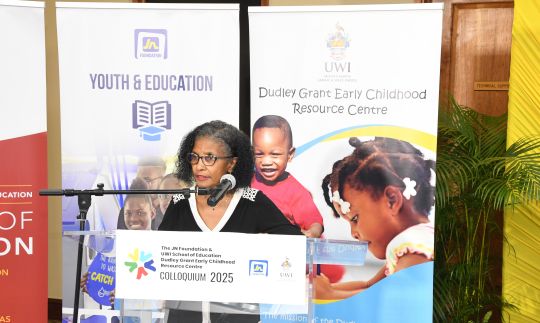
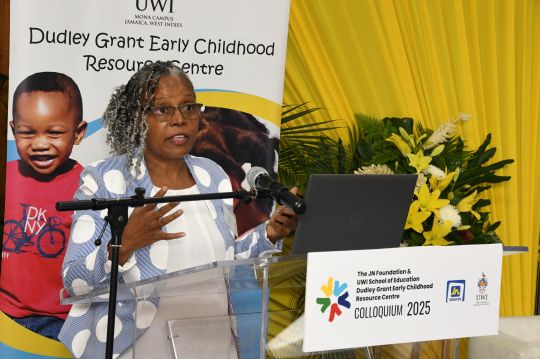
Delivering the first of two keynote addresses on the opening day of the JN Foundation and The University of the West Indies (UWI) School of Education Dudley Grant Early Childhood Resource Centre Colloquium on the topic, Nurturing Well-Being and Building Resilience, the specialists, Professor Loraine Cook and Dr Sharline Cole, from the School of Education at UWI Mona, argued that Jamaica must reshape how it educates and protects children. This includes their educators, both during crises and in the classroom before and after events.
Professor Loraine Cook
They noted that as the country remains vulnerable to climate-driven disasters, children should be empowered as “agents of protection in disasters”. They called on authors to write textbooks and storybooks featuring disaster-management techniques so children can process risk and prepare through familiar characters and culturally relevant storytelling. “Present it so that children from as early as three can start understanding what vulnerabilities they will face in society,” said Professor Loraine Cook.
The education psychologists also stressed the need to continue improving school infrastructure across the country to be hurricane resilient, as many remain vulnerable to high-impact weather systems.
They also pushed for a stronger national remote learning strategy. This strategy would be built on both online and offline methods to ensure continuity of education when schools are damaged or inaccessible. Citing an effective model from another disaster-prone country, Belize, Professor Cook said, “they utilise transistor radios to bring learning into the homes and I think that’s fantastic. It is so flexible, you don’t just rely on the internet.”
The Cuban Model
Beyond that, the psychologists urged education stakeholders in Jamaica to adopt international best practices that teach young children practical disaster preparedness skills.
Using Cuba as a case study, Dr Cook shared how early childhood schools integrate a “culture of prevention” into their curriculum, preparing children for disasters. They use age-appropriate activities like drills, storytelling and themed games.
The schools teach young children to recognise risks and react to emergencies with calmness and safety. She added that in primary schools, students from grades one to six also study their natural surroundings. They learn about the environment through daily observation.
“The goal is for children to become agents of change by applying and sharing what they learn both within their families and across their communities,” Professor Cook shared.
Redesign of the Education System
Dr Sharline Cole added that in the redesign of the education system, children must be encouraged to express and validate their emotions as part of disaster recovery.
Dr Sharline Cole
“Children have a say, and we should provide them with an opportunity to say what they feel and understand their emotions. Let them share exactly what is happening to them because if they don’t, it’s going to create problems later on. We have to listen to what they have to say and help them to talk about it,” she said.
The psychologists pointed out that the need for change goes beyond just students. They noted that teachers have some skills to help with mental and social issues. However, teachers face a big challenge. They must deliver lessons while also dealing with students’ traumatic experiences.
To ease this burden, they recommended that the Ministry of Education, Skills, Youth and Information partner with universities and counsellor-training institutions to implement a structured national internship programme.
Under the proposal, mental health trainees would work alongside classroom teachers. They would provide socio-emotional support during instructions, helping to stabilise the classroom environment and improve academic performance.
Adaptive Education System Needed
The specialists highlighted the need to support teachers’ well-being. They also called for a more flexible education system. This system should adapt quickly during emergencies and be guided by data.
They asked the Office of Disaster Preparedness and Emergency Management (ODPEM) to gather and share data. This data should show how well the current Guidelines for Child-Friendly Disaster Management and Response are working.
This data would assist in policies reflecting the realities children face before, during and after disasters.
“Despite having the guidelines, the Government faces challenges in implementing child protection in emergencies as a central focus of their operations,” Dr. Cole said, citing a 2019 statement from the Caribbean Disaster Emergency Management Agency (CDEMA).
“We have the guidelines [but] are we putting them into action and does it end there?” she questioned. “We need the data to guide our practice, to make the appropriate implementation or to make decisions. If we don’t have that data, it’s difficult for us to make informed decisions, be able to plan and ensure we have a resilient society,” she concluded.
The two-day colloquium was held from November 27-28 at the UWI Regional Headquarters, under the theme: Let’s shape tomorrow, together.It gathered teachers, policymakers, and leaders. They discussed early childhood education in the region. They also planned for the future.
Used by Google Analytics to determine which links on a page are being clicked
30 seconds
_ga_
ID used to identify users
2 years
_gid
ID used to identify users for 24 hours after last activity
24 hours
_gat
Used to monitor number of Google Analytics server requests when using Google Tag Manager
1 minute
_gac_
Contains information related to marketing campaigns of the user. These are shared with Google AdWords / Google Ads when the Google Ads and Google Analytics accounts are linked together.
90 days
__utma
ID used to identify users and sessions
2 years after last activity
__utmt
Used to monitor number of Google Analytics server requests
10 minutes
__utmb
Used to distinguish new sessions and visits. This cookie is set when the GA.js javascript library is loaded and there is no existing __utmb cookie. The cookie is updated every time data is sent to the Google Analytics server.
30 minutes after last activity
__utmc
Used only with old Urchin versions of Google Analytics and not with GA.js. Was used to distinguish between new sessions and visits at the end of a session.
End of session (browser)
__utmz
Contains information about the traffic source or campaign that directed user to the website. The cookie is set when the GA.js javascript is loaded and updated when data is sent to the Google Anaytics server
6 months after last activity
__utmv
Contains custom information set by the web developer via the _setCustomVar method in Google Analytics. This cookie is updated every time new data is sent to the Google Analytics server.
2 years after last activity
__utmx
Used to determine whether a user is included in an A / B or Multivariate test.
18 months
Google reCAPTCHA helps protect websites from spam and abuse by verifying user interactions through challenges.
Name
Description
Duration
_GRECAPTCHA
Google reCAPTCHA sets a necessary cookie (_GRECAPTCHA) when executed for the purpose of providing its risk analysis.