
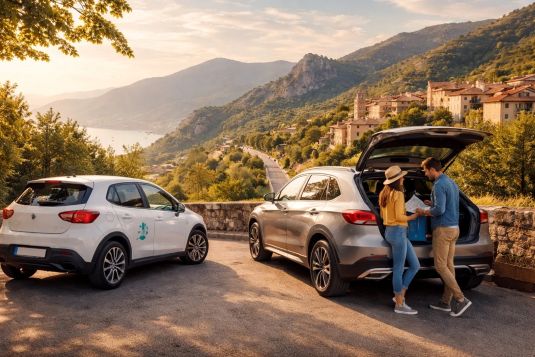
Traveling across Europe by car has long ceased to be a niche experience. A dense road network, short distances between countries, and an exceptional variety of routes have made road trips one of the most flexible ways to explore the continent. At the same time, access to a car has changed noticeably over the past decade. Traditional car rental is no longer the only option, while car sharing has become an established part of Europe’s mobility landscape.
This shift is especially visible in major cities and popular travel regions. Europe has developed a layered mobility ecosystem in which classic car rentals coexist with minute-based and hybrid services. These models evolve differently depending on the country, but the overall direction is clear: cars are no longer tied to a single usage format. In this context, the experience of operators working across multiple markets is particularly revealing. One example is Getmancar, which adapts its approach by combining elements of traditional rental and car sharing depending on local conditions and real-world use cases.
Traditional Car Rentals: The Backbone of European Road Trips
Classic car rental remains the foundation of long-distance travel in Europe. It continues to be the most practical option for multi-city routes, cross-border journeys, and trips where luggage space, flexibility, and autonomy matter. Airports, major train stations, and transport hubs remain the primary pickup points, making rentals a natural choice for travelers arriving from abroad.
While the rental process has become more digital, its core logic has not changed. Travelers book a car for a defined period and use it without worrying about coverage zones or city-specific return rules. This model supports complex itineraries—from Alpine passes to coastal highways—without constant logistical constraints.
Car Sharing as an Urban Mobility Tool
Car sharing in Europe has developed primarily as a city-based solution. In large metropolitan areas, it has become part of everyday mobility alongside public transport and cycling. Its key advantage is immediacy: cars are available on demand, often without advance planning.
However, car sharing rarely replaces rental entirely. It works best for short trips, errands, and inner-city movement but becomes less practical for long distances or cross-border travel. Strict zoning rules, parking regulations, and service boundaries make car sharing efficient within cities but limited beyond them.
How Europe Moved Toward Hybrid Use
One of the defining features of the European market is how naturally the two models complement each other. Many travelers combine them: renting a car for regional travel while relying on car sharing in large cities where private vehicles can become inconvenient.
Operators have adjusted accordingly. More services now offer hourly, daily, and multi-day options within the same ecosystem. This reflects actual travel behavior rather than theoretical models—today’s traveler may drive across regions one day and rely on urban mobility solutions the next.
Different Countries, Different Mobility Patterns
There is no single “European” way to use a car. In Italy and Spain, cars remain essential for exploring regions, coastlines, and smaller towns. In Germany and the Netherlands, car sharing is deeply embedded in city life, while traditional rentals dominate long-distance travel. In parts of Eastern Europe, rentals often prevail due to fewer restrictions and simpler usage rules.
For travelers, this means one thing: the right choice depends on the route, not on trends or marketing narratives.
What Actually Matters When Traveling by Car in Europe
Planning a European road trip requires awareness of local regulations. Toll roads, environmental zones, insurance requirements, and city access rules can significantly shape an itinerary. In this context, traditional rentals often offer greater predictability, especially for first-time visitors.
Car sharing demands closer attention to service rules, including drop-off zones, penalties, and liability terms. It works best as a complementary option rather than a universal solution.
Berlin as a Case Study of Combined Mobility
Berlin illustrates Europe’s blended approach particularly well. Within the city, car sharing allows residents and visitors to move freely without owning a vehicle. Outside the city limits, however, traditional rental becomes the more flexible option.
For travelers planning trips beyond Berlin itself, car rental in Berlin remains the most practical way to explore Germany without being constrained by city-based service zones or time limits. This balance between rental and car sharing reflects how the two models coexist rather than compete.
How Car Rentals and Car Sharing Compare in Practice
| Travel Scenario | Car Rental | Car Sharing |
| Multi-city or cross-border travel | Ideal and unrestricted | Usually impractical |
| Urban short trips | Often inconvenient | Highly efficient |
| Advance planning | Required | Optional |
| Pricing structure | Daily or multi-day | Time-based |
| Parking flexibility | Depends on city rules | Often integrated with local policy |
| Best suited for | Road trips, families, luggage-heavy travel | City stays, short errands |
| Risk management | Clear at pickup and return | Often resolved post-trip |
Europe offers travelers an unusually flexible approach to car-based mobility. Car rental and car sharing are no longer competing concepts but complementary tools designed for different situations. Understanding how and when to use each allows travelers to build smarter routes with fewer compromises.
Traveling Europe on wheels today is less about choosing a single service and more about adapting to the journey itself. That flexibility has become the defining feature of modern European mobility.